
Brand vs Generic in Google Ads: Why Separation Creates Room for Growth
- Mai 28, 2026
- Uncategorized
Most mid-scale e-commerce Google Ads accounts start with one overall target ROI, profitability goal or CAC target. At first this sounds completely logical. The business does not care whether revenue comes from Search Brand, Shopping Brand, PMAX or Generic Search. The business wants profitable growth.
Fair enough. But inside Google Ads, this overall target can become very misleading once brand and generic traffic are heavily mixed together. Because brand and generic are not the same thing. Brand traffic is usually demand capture. Generic traffic is usually demand acquisition. Brand traffic converts better because users already know the company, trust the brand or are intentionally searching for it. Generic traffic is usually more expensive, more volatile and much harder to scale profitably. And this is where many accounts quietly become misleading. Because if brand and generic are blended together, the account may still look healthy overall while the generic acquisition layer is actually struggling underneath.
Sometimes overall ROAS is not performance. Sometimes it is simply brand demand wearing a nice suit. And this is exactly why separating brand and generic traffic becomes strategically important. Not because campaign structure should look prettier. The real reason is strategic control. Because once the account reaches enough scale, the challenge is no longer simply: “Make the account profitable.” The real challenge becomes: How do we improve efficiency inside stable demand capture so we can create more room for generic growth?
Because generic acquisition is expensive. And if we can capture branded demand more efficiently, we suddenly create breathing room elsewhere in the account, e.g. extending keyword coverage, scaling broader acquisition areas, testing new audiences thereby increasing growth potential while maintaining the overall account tROAS goal.
One thing I see very often in e-commerce accounts is this: The account technically has multiple campaigns. But intent is still mixed everywhere. Generic Search still captures branded traffic, especially with AI Max for Search switched on. PMAX quietly absorbs branded demand in the background. Shopping overlaps with everything. As a result, brand and generic ROAS become blended together, creating a beautifully profitable-looking but strategically confused performance soup. And this is where bad decisions usually begin. Because mixed intent creates mixed conclusions. And mixed conclusions create expensive scaling decisions.
The Structure I Usually Prefer For Mid-Scale E-Commerce Accounts
This setup is not about creating more campaigns for the sake of complexity. The goal is: clearer economics, clearer intent, and clearer strategic control. Especially once the account already has enough conversion volume (100+ monthly purchases per campaign in e-commerce). Smaller accounts often need consolidation first. But mature, grown-up accounts usually need separation. Also, if you are already operating on a more advanced level using LTV optimization, separating new vs existing customers, using different marketing communications and separate ROI goals, then pure brand vs generic separation may become slightly less relevant because customer lifecycle segmentation already creates additional strategic clarity.
Search Brand
Purpose:
Capture branded search demand efficiently and intentionally.
Setup:
– only clear brand keywords
– separate budget
– separate tROAS expectations
– separate CPC monitoring
– no generic keywords.
Examples:
[brand]
“brand backpacks”
“brand shoes”
etc.
This becomes the clean branded text-ad layer, if you are careful with the match types and not using broad match here. Depending on the account, this can sometimes become surprisingly efficient compared to Shopping Brand.
Search Generic
Purpose:
Measure true non-brand acquisition performance.
Setup:
– exclude all brand keywords
– evaluate profitability separately from brand.
This is extremely important. Because if brand keywords leak into generic campaigns, generic performance starts looking healthier than it really is.
AI Max for Search / Search Expansion
If AI Max or Search expansion is used inside Generic Search campaigns:
– apply brand exclusions
– monitor search terms carefully
– prevent branded demand from leaking back into generic campaigns.
Otherwise Generic Search slowly becomes: “brand traffic with better storytelling.”
PMAX Generic
Purpose:
Use PMAX mainly as a generic acquisition and scaling layer.
Setup:
– exclude brand terms
– separate PMAX from branded demand capture
– evaluate PMAX independently from branded performance
– monitor performance after brand exclusions carefully
This is often emotionally uncomfortable. Because sometimes PMAX performance suddenly drops after excluding brand. But this does not always mean PMAX became worse. Sometimes it simply means the campaign stopped taking credit for people who already wanted the brand anyway. And honestly, many accounts become healthier once PMAX stops quietly harvesting branded demand in the background.
Shopping Brand
Purpose:
Controlled branded Shopping demand capture.
Setup:
– separate Shopping Brand campaign
– exclude generic keywords/search terms where possible
– often use relatively high tROAS targets
– structure the campaign so it mainly serves branded Shopping demand
The goal is usually not aggressive scaling here.The goal is: high-efficiency branded capture. Shopping Brand should behave like a disciplined profitability layer. Not like a generic campaign that suddenly discovered freedom and started running through every product query. And depending on the account, Shopping Brand can either become very efficient or become surprisingly expensive. Which is exactly why separate analysis matters.
Shopping Generic (optional).
If a strong PMAX Generic setup already exists, Shopping Generic is often lower priority and not always necessary. In many e-commerce accounts, PMAX already acts as the main generic Shopping and acquisition engine.
Shopping Generic mainly becomes useful for:
– additional query control
– feed segmentation
– margin protection
– CPC stabilization
– testing specific product groups.
PMAX is often the scalable “muscle.” Standard Shopping is usually more the “scalpel.”
Relationship between Search Brand and Shopping Brand
One interesting thing we observed across several e-commerce accounts was that the relationship between Search Brand and Shopping Brand was much more nuanced and interdependent than it initially appeared. First of all, Search Brand and Shopping Brand are not simply two campaigns fighting for one identical placement. They are different ad formats with different placement behavior inside the SERP. In many cases, the same advertiser can appear simultaneously with both a Shopping ad and a Search ad on the same branded query.
Sometimes Shopping placements dominate visibility visually through product images and pricing. In other situations, Search ads receive stronger engagement and capture intent more efficiently. So the goal is usually not choosing one or the other. In many cases, both are needed as part of the branded demand capture strategy.
The more interesting question is: Where can branded demand currently be captured more efficiently? Depending on budget limitations, auction behavior, CPC pressure, feed quality, SERP layout and conversion behavior, Shopping Brand can sometimes become more efficient. And in other accounts, shifting more branded demand intentionally toward Search Brand reduced costs significantly. Especially in accounts where overall budgets were restricted, Shopping Brand CPCs became relatively expensive or Search Brand captured branded intent more efficiently. Because the goal is not simply making branded campaigns cheaper. The real goal is to create room for scalable acquisition while keeping the overall account profitability stable.
Simple Search Brand vs Shopping Brand Analysis Template
To analyze this properly, I created a simple comparison template for Search Brand vs Shopping Brand performance. The goal of the template is not simply comparing CPCs.
The goal is understanding:
– where branded demand is captured more efficiently
– how costs develop over time
– how revenue behaves across both branded layers
– and whether branded efficiency creates more room for generic growth.
The template compares monthly development of the main KPIs incl. Costs, Revenue, CPC, cost share and revenue share for Search Brand and Shopping Brand separately as well as for both of them together. As a result, we can visualize how branded demand shifts between both campaign types over time and where branded traffic is currently cheaper or more profitable to capture.
I also added a simple monthly line graph comparing revenue development and cost development across both branded structures. Especially in budget-restricted accounts, this becomes a strategically controllable lever.
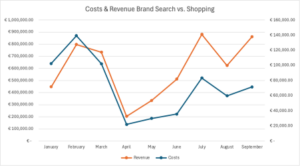
The interpretation is intentionally simple: If the revenue line stays significantly above the cost line while branded demand is still fully covered, then branded efficiency is improving. And this is strategically very important. Because if we increase ROI inside the branded layer, we create more financial breathing room for the generic acquisition layer.
The objective is creating stronger overall growth potential while still maintaining the overall account tROAS target. The percentual difference also gives us additional clarity about the absolute cost savings for the specific month accordingly, while largely ruling out seasonality effects through the direct monthly comparison between Search Brand and Shopping Brand.
More from our blog
See all posts


Pingback: cyclosporine immunomodulator
Pingback: who makes tadalafil
Pingback: orlistat commercial name
Pingback: dexlansoprazole 60 mg price
Pingback: prescribed antibiotics online