
How to Audit a Google Ads Account Without Overwhelming the Client
- Mai 17, 2026
- Uncategorized
A Google Ads audit is usually one of the first deeper interactions with a potential new client. This means the goal is not only to identify problems.
The goal is also:
– to build trust
– reduce overwhelm
– create clarity
– show structured thinking
– make the client feel safe working with you
Many freelancers make the mistake of trying to prove expertise by aggressively criticizing the existing setup. But behind every account there are real people: another freelancer, an internal team, a previous agency or sometimes even the client themselves. If your audit feels too aggressive, emotional, or chaotic, you can lose the client very quickly. A good audit should feel calm, structured, and solution-oriented and less like a public execution of the previous agency or account manager.
My Preferred Audit Structure
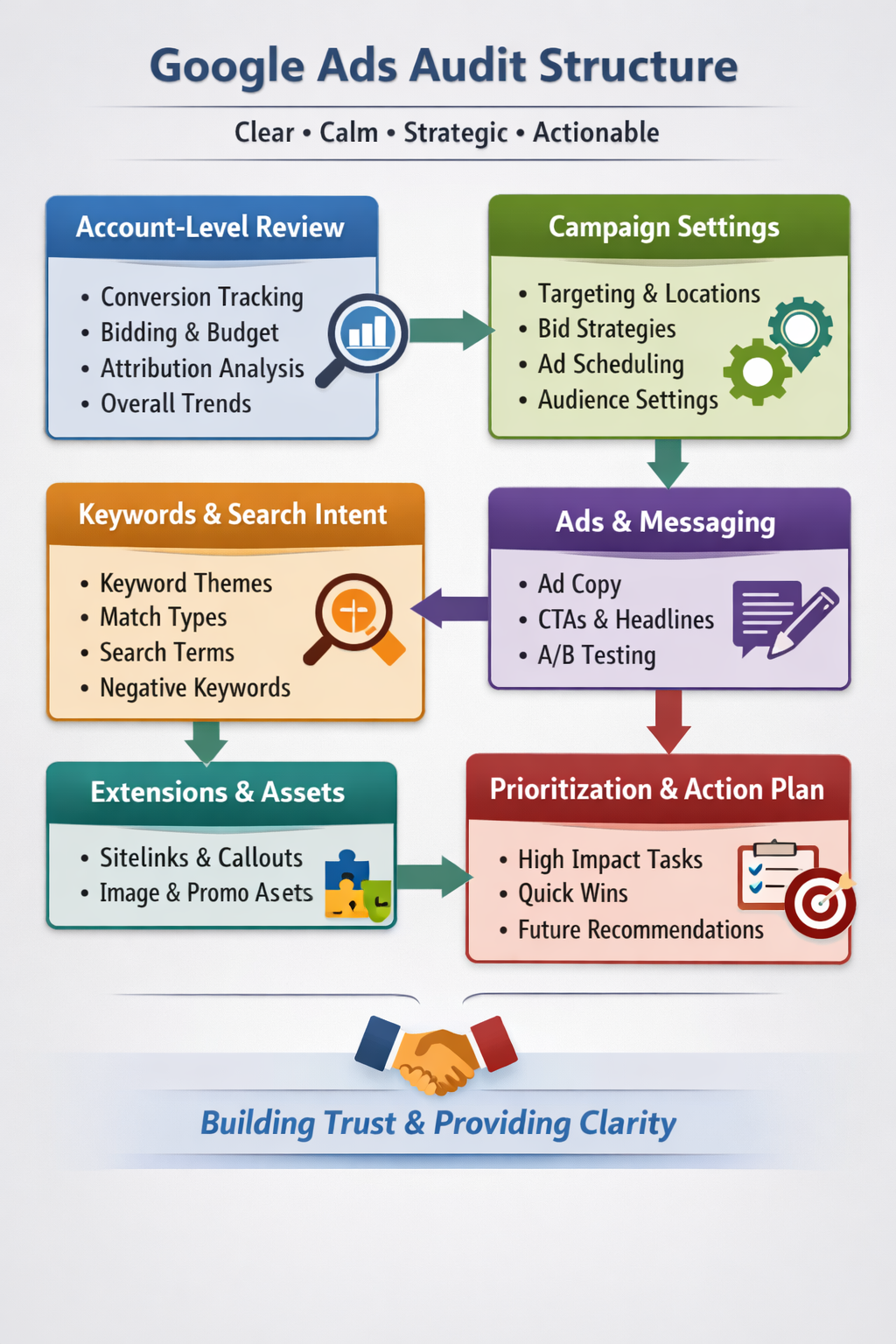
For most mid-sized accounts, a practical audit can usually be done within 4–6 hours. Depending on the complexity, audits can realistically take anywhere between 2 and 16+ hours. It does not need to become a 100-page document. Simple structured observations with screenshots are often enough.
I usually work through the account in this order:
1. Account-Level Review
Start with the bigger picture first:
– conversion tracking
– attribution settings
– bidding strategies
– budget allocation
– account structure
– seasonality
– overall CPC / ROAS trends
– brand vs generic spend split.
The goal here is to identify patterns before looking at details.
For example:
– rising CPC pressure
– declining click share
– budget imbalance/restriction
– inconsistent tracking
– overreliance on brand traffic.
This creates strategic context for the rest of the audit.
2. Campaign Settings
Then move into campaign-level structure:
– location targeting
– language settings
– bid strategies
– network settings
– ad schedules
– device adjustments
– audience signals
– campaign priorities
– PMAX vs Search overlaps
This is often where structural inefficiencies appear.
Focus on opportunities, not blame.
Instead of:
“This setup is wrong.”
Prefer:
“This structure may create overlap or reduce control.”
3. Keywords & Search Intent
Next:
– keyword themes
– match types
– search intent
– search term quality
– negative keywords
– click share
– impression share
– historical quality factors (check all 3 factors: ad relevance, predicted CTR and landing page experience).
I usually focus more on patterns and prioritization rather than listing hundreds of keyword issues.
For example:
– strong CPC inflation
– broad match without sufficient control
– weak search intent alignment
– low click share in important categories.
4. Ads & Messaging
Then review:
– ad copy structure
– messaging consistency
– emotional positioning
– CTA clarity
– RSA quality (Ad Excellence)
– testing variations
– asset diversity.
Many accounts focus too heavily on technical optimization and ignore messaging psychology. Sometimes small messaging improvements can have bigger impact than structural changes.
5. Extensions / Assets
Review:
– sitelinks (min. 6)
– callouts (min. 6)
– snippets (min 1)
– image assets (min 1)
– promotion assets (if applies)
– location assets (if applies)
This is often overlooked but important for CTR and overall ad quality.
6. Prioritization
One of the biggest mistakes in audits is giving the client too many actions at once. I prefer dividing findings into: high impact / medium impact / low impact or /and future testing ideas. This reduces overwhelm and creates clearer next steps.
Turning the Audit Into an Action Plan
An audit should not end with observations alone. The real value comes from translating findings into practical actions, priorities, timelines and implementation structure. This is especially important because clients often feel overwhelmed after audits if there is no clear next step. I usually convert the audit into a structured action plan template containing my observations, recommendations, expected impact, implementation difficulty, estimated time effort, responsibilities and current status (for follow-ups).
This creates a much calmer and more actionable process for both the freelancer and the client. It also helps transform the audit from a theoretical document into a practical working roadmap. And in many cases, this naturally leads into ongoing implementation work, because the client already sees the structure, the strategic thinking and the practical next steps.
A simple but well-structured implementation template is often more useful than overly complex documentation, f.e.
| Priority | Category | Observation | Recommendation | Expected Impact | Difficulty | Estimated Time | Responsible | Status | Notes |
| High | Tracking | Conversion tracking inconsistent across campaigns | Review and standardize primary conversion setup | Higher data quality | Medium | 2h | Freelancer / Client | Open | |
| High | Campaign Structure | Brand and generic campaigns overlap | Separate campaign intent more clearly | Better budget control | Medium | 3h | Freelancer | Open | |
| Medium | Keywords | Broad match generates low-quality traffic | Add negatives and refine keyword structure | Improved efficiency | Medium | 2h | Freelancer | Open | |
| Medium | Ads | Messaging inconsistent across ad groups | Align ad copy with search intent | Higher CTR | Low | 1h | Freelancer | Open | |
| Low | Assets | Missing sitelinks and callouts | Expand asset coverage | Higher ad relevance | Low | 1h | Freelancer | Open |
You can download my generalized Google Ads Audit Action Plan Template here:
Google_Ads_Audit_Action_Template
Audits Require A Lot of Cognitive Energy
A good Google Ads audit is mentally demanding work. You are constantly analyzing patterns, prioritizing opportunities, interpreting incomplete data, understanding business context. This type of deep analytical work requires a very high level of cognitive energy and experience.That is also why audits should not be massively underpriced. Clients often only see the final document. They do not see the 47 open tabs, internal debates and temporary identity crises behind it. They do not see the years of experience and pattern recognition required to quickly identify what actually matters. A strong audit is not just information. It is strategic clarity.
AI Can Assist Audits But Not Replace Real Expertise
AI can absolutely help generate audit recommendations. It can also confidently recommend things that make absolutely no sense in the real business context. But a truly valuable audit still requires human judgment, prioritization, emotional intelligence and pattern recognition developed through experience.
An experienced expert understands which problems actually matter and which recommendations are realistic as well as how to communicate findings without creating resistance and how to adapt the audit to the client’s emotional and business situation. That human layer cannot simply be automated. The best audits are not created by dumping data into AI. They are created by combining structure, experience, strategic thinking, and calm communication – by a human experienced expert;-)
More from our blog
See all posts


Pingback: finpecia finasteride
Pingback: semaglutid tablett reseptfritt
Pingback: semaglutide pillen
Pingback: mesalamine missed doses
Pingback: vidalista black pill
Pingback: creon hair loss
Pingback: cenforce 200 black pill
Pingback: minoxidil for men beard
Pingback: zudena 200 udenafil tablet
Pingback: lasix water pill
Pingback: nitrofurantoin mono 100mg tab
Pingback: metoprolol succinate 50 mg price
Pingback: vardenafil 20mg