
How I Structure My Workday as a Digital Freelancer to Avoid Mental Overload
- April 17, 2026
- Uncategorized
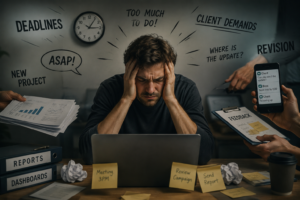 One thing I realized after years of freelancing is that mental exhaustion often does not come from the amount of work itself. It comes from constant switching. Switching between meetings, clients, reports, dashboards, Slack messages, notifications, campaign performance, and urgent requests. Especially in digital marketing, your brain rarely fully relaxes.Sometimes it feels like your nervous system has 47 browser tabs open permanently.
I think many freelancers technically have freedom, but mentally still work as if they are trapped in continuous office hours. I noticed this in myself too. Even when working remotely, it is very easy to feel constantly “on” mentally. Freelancing freedom sometimes quietly turns into carrying your office inside your nervous system.
One thing that helped me a lot was becoming much more intentional about how I structure my workday.
For example, I try to group meetings closer together instead of spreading them randomly across the entire day. Some meetings are fixed by the client or by the company, especially larger team meetings where you simply need to adapt. But many recurring calls, weekly updates, or strategy meetings can actually be discussed and scheduled more intentionally.
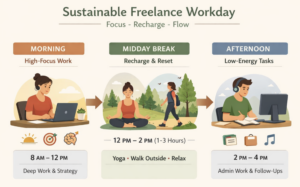
Personally, I prefer having most meetings either in the morning or grouped closer together with small breaks in between. Those breaks are extremely important. Not only to have a coffee or go to the bathroom, but also to mentally wrap up the previous meeting before immediately jumping into the next one. Without small mental breaks, back-to-back meetings slowly start feeling like cognitive speed dating.
 I also noticed that many small tasks are much easier to finish directly after the meeting while the context is still fresh in my head. Sometimes just having 20–30 minutes between meetings helps me quickly write down action points, organize priorities, and mentally reset before the next conversation starts. Otherwise by meeting number four, your brain starts confusing clients, campaigns, conversations and probably your own identity a little bit.
I realized I work much better when I intentionally step away for a while. Going outside, going to yoga, walking in nature, exercising, shopping, or simply leaving the screen for some time helps me mentally refresh. Then when I return for the second part of the day, I feel much more stable mentally and can focus much better again.
One thing that helped me a lot as a freelancer was also learning to separate cognitively demanding work from more flexible, lower-energy tasks. I think this is actually one of the biggest advantages of freelancing and remote work if you learn how to use it correctly.
Not every task requires the same amount of mental energy.
For example, strategic audits, QBR presentations, reporting summaries, analyzing campaign trends, or writing recommendations for clients usually require a very high level of concentration. The same when you start working on a completely new account. Your brain consumes a lot of energy because you constantly need to process new information, understand structures, identify patterns, and make strategic decisions.
Operational campaign management often feels different. When you work every day with the same accounts, you already know the campaigns, the structures, and the client expectations. That work usually requires less cognitive energy because many decisions become more intuitive over time.
Then there are even lighter tasks that can almost become “background tasks.” Things like formatting reports, organizing files, renaming assets, uploading documents, cleaning spreadsheets, or smaller repetitive adjustments. Sometimes those tasks can even be done while listening to music or slowing down mentally a little bit.
What changed a lot for me was understanding this difference and planning my days accordingly instead of expecting myself to perform at maximum cognitive capacity all day long.
For the more demanding strategic work, I now try to create calmer conditions. Less distractions, less multitasking, sometimes silence or focus music instead of normal music. Strategic work requires a completely different type of energy than operational work.
Another thing that still helps me a lot is writing things down physically on paper. Even though tools like Asana, Teams notes, and task management systems are extremely useful, handwritten notes still create a different type of clarity in my head, especially during meetings. If you are a visual person, simple paper notes can honestly work much better than trying to organize every thought digitally.
I think many freelancers become exhausted because they treat all work as equal mentally, but it is not.
Once you start separating:
- high-focus work
- operational work
- flexible tasks
- recovery time
freelancing becomes much more sustainable psychologically.
One of the most important things I learned is this:
When you are mentally exhausted, pushing harder usually does not create better work. At some point your brain stops producing strategic thinking and starts producing emotionally ambitious nonsense, causing more stress, more mistakes, worse decisions, and emotional overload.
Sometimes the most productive thing you can do is simply step back for a moment. Breathe, walk, eat properly, calm your nervous system, and then return with a clearer mind.
Freelancing becomes much more sustainable once you stop treating yourself like a machine and start building systems that actually support your mental energy instead of constantly draining it.
Simple Cognitive Energy Mapping Framework
One practical thing that helped me personally was mentally separating tasks into three categories:
| Task Type | Energy Level | Best Conditions |
|---|---|---|
| 🔥 Strategic Work | 🔺 High | 🌅 Morning • 🤫 Silence • 🎯 Deep Focus |
| 🔧 Operational Work | 🔸 Medium | 📚 Structured Work Blocks |
| 🌙 Flexible Tasks | 🔻 Low | 😌 Lower‑Energy Periods |
This sounds simple, but once you start organizing your days around mental energy instead of only time, freelancing becomes much calmer and much more sustainable long term.
More from our blog
See all posts


Pingback: cenforce 100 vs cialis
Pingback: allopurinol 300 mg tablet price
Pingback: mobic 15 mg price
Pingback: metoprolol used for
Pingback: z-pak